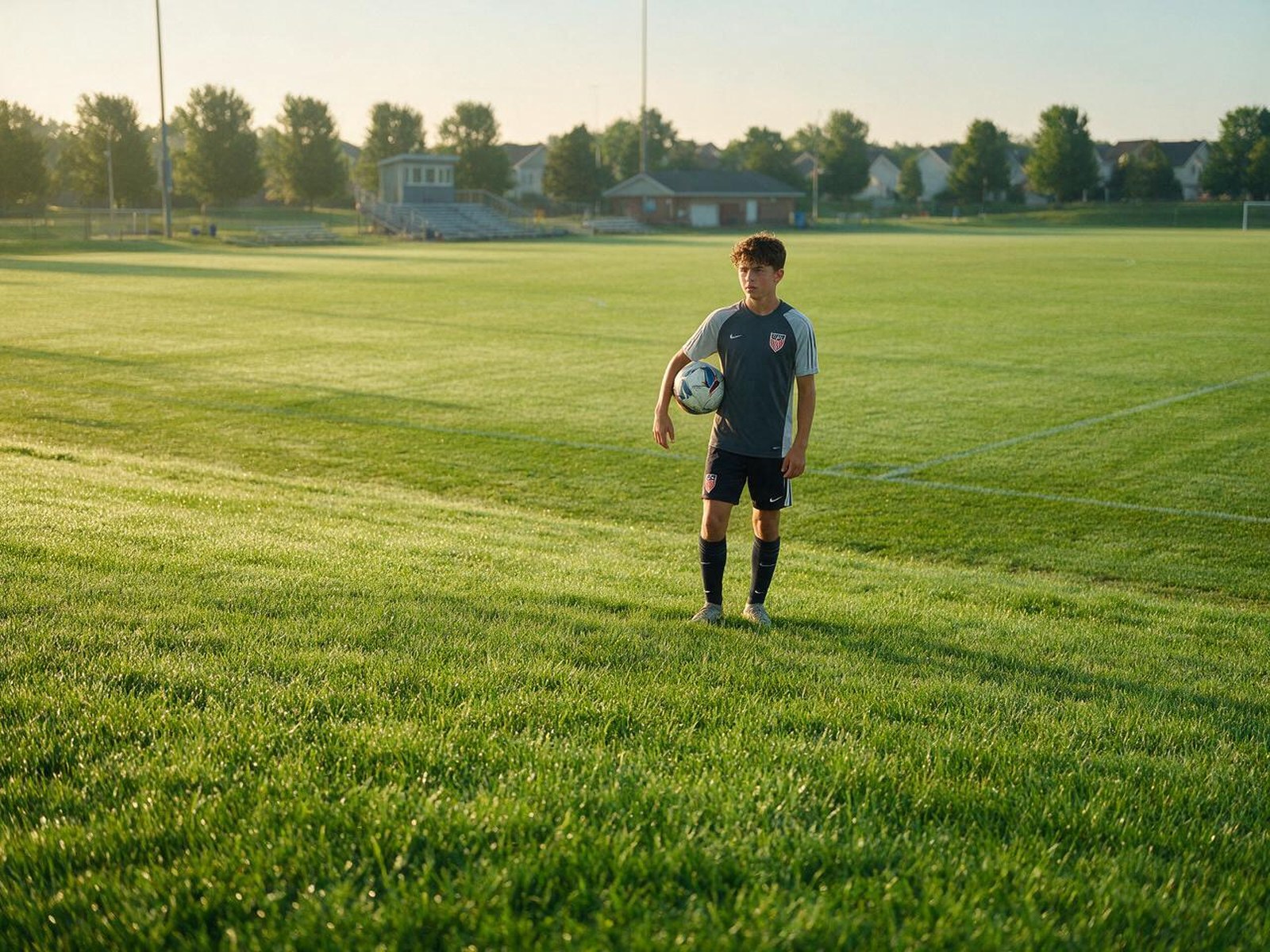
For most American players with serious soccer ambitions, the realistic next step is a college roster, not a pro contract. College soccer is a genuine level of the game, and the route into it runs through the classroom as much as the field. Here is how the pathway actually works.
The college levels
College soccer is not one league. It is several, each with its own rules on recruiting, academics and money.
| Level | What to know |
|---|---|
| NCAA Division I | 361 schools across all sports. Generally the highest level of competition and the most athletics scholarships. |
| NCAA Division II | 296 schools, using a partial-scholarship model. |
| NCAA Division III | 416 schools, the largest division. No athletics scholarships, though most athletes receive other financial aid. |
| NAIA | A separate association with its own eligibility center and few restrictions on contact with coaches. |
| Junior college | Two-year colleges, often called community colleges. A place to keep playing, build grades and aim for a four-year school. |
Scholarships: mostly partial, and changing
Soccer has long been an "equivalency" sport: each program shares a pool of scholarship money across its roster. Division I programs could historically award at most 9.9 scholarship equivalents in men's soccer and 14 in women's, so partial awards were the norm.
The House v. NCAA settlement changed that from July 1, 2025. Division I schools that opt in to the settlement no longer have a sport-by-sport scholarship limit and may give full or partial aid to anyone on the roster. In exchange, they must cap rosters at 28 players in both men's and women's soccer. Schools that do not opt in stay within the old aid limits and are not bound by the roster caps. Opting in does not oblige a school to fund more scholarships, and a hard cap can leave less room for walk-ons, so ask each program how it works now.
Keep perspective: across all sports, the NCAA says only about 2% of high school athletes are offered athletics scholarships.

Grades are part of the pathway
- Division I: 16 NCAA-approved core courses, 10 of them (seven in English, math and science) finished before your seventh semester, and at least a 2.3 core-course GPA.
- Division II: 16 core courses and at least a 2.2 core-course GPA.
- Division III: each school sets its own academic standards.
- NAIA: register at PlayNAIA.org. Incoming freshmen must graduate with a 2.3 GPA or meet two of three standards: an 18 ACT or 970 SAT, a 2.0 GPA, or the top half of their class.
Divisions I and II dropped test scores from eligibility in 2023, but schools may still want them for admission. Eligibility is not admission: you still have to get in.
What actually moves the needle
- Play at the right level, consistently. Our guide to US youth soccer leagues explains the options.
- Get seen. Email coaches with a highlight video, and choose ID camps and showcases carefully.
- Know the calendar. NCAA rules control when coaches can contact you; see the recruiting timeline.
- Develop the whole player. Work across all four pillars, not just one standout skill.
College coaches recruit players who are still improving. Take the free development assessment to see which parts of your game to work on next - it describes where your game is today and does not predict whether you will play in college.
Sources: NCAA Guide for the College-Bound Student-Athlete 2026-27; NCAA Proposal 2025-11; NCAA House settlement Q&A; NCAA Division I Manual 2021-22; NAIA college-bound guide.
Frequently asked questions
How many soccer scholarships does a college team have?
It depends on the level and, in Division I, on the school. Since July 1, 2025, Division I schools that opt in to the House settlement have no sport-specific scholarship limit but cap soccer rosters at 28, while schools that do not opt in stay within the old limits (historically 9.9 for men and 14 for women). Division III offers no athletics scholarships.
What GPA do you need to play college soccer?
NCAA Division I requires at least a 2.3 GPA in 16 NCAA-approved core courses, and Division II requires at least 2.2. NAIA freshmen must graduate with a 2.3 GPA or meet two of three standards on test scores, GPA and class rank, while Division III schools set their own standards.
Is 11th grade too late to start the college soccer process?
No. The NCAA says recruiting can begin as early as ninth grade but in most cases starts in 11th grade. Make sure your core courses and grades are on track, and contact coaches at schools that fit.
Curious where you actually stand? Soccer Reach turns your level, age and honest self-assessment into a free Player Development Score, with the parts of your game to work on next.
Get your free score